

A concept developed by DDlx Informatics GmbH
Betina is the company’s Swiss army knife: just about anything you hand her, she finds a way to get done. One more job does not call for one more piece of software, only one more rule — written in plain language, within anyone’s reach.
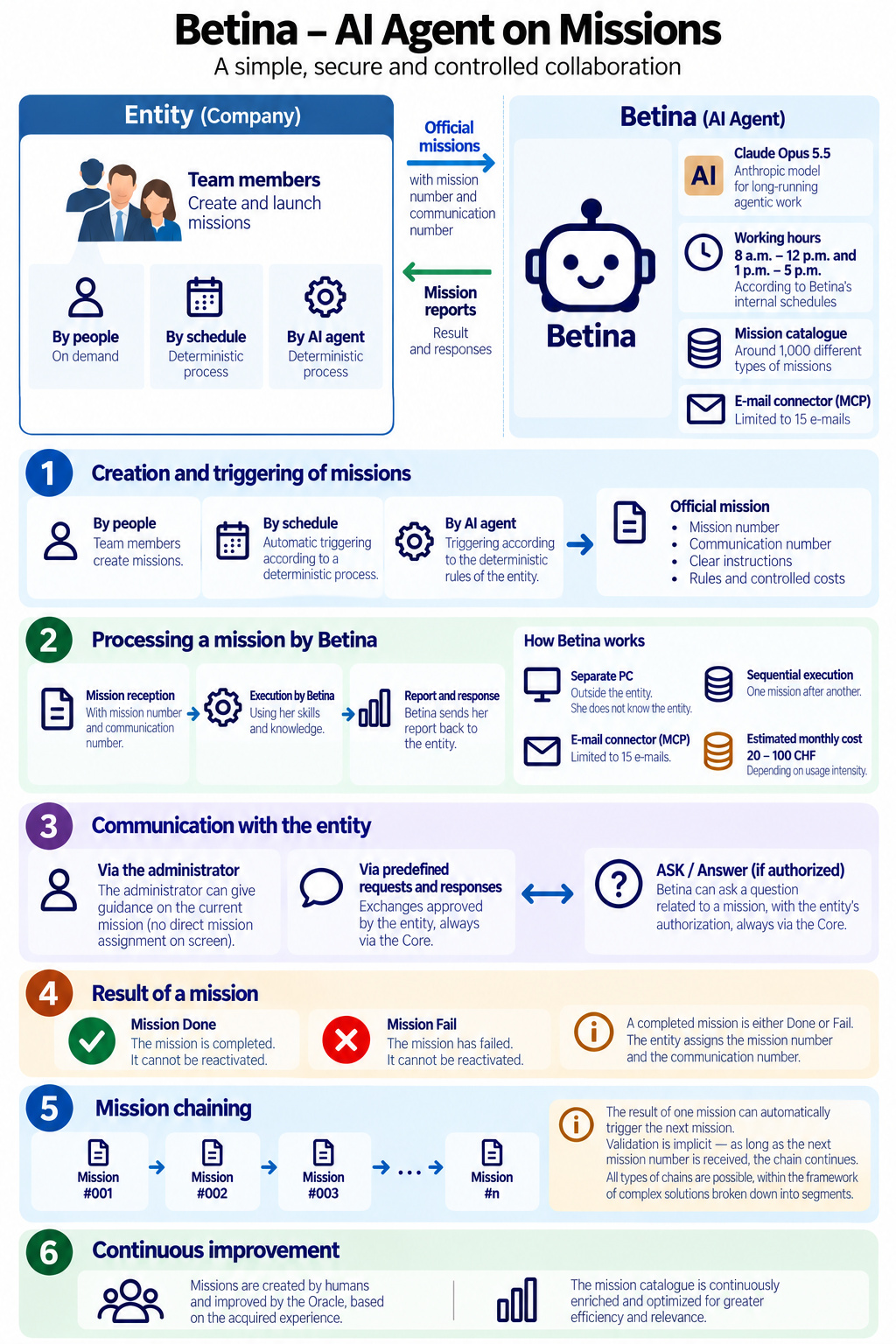
Betina runs on a PC separate from the company. She works on the basis of missions to be completed, from 8 a.m. to 12 noon and from 1 p.m. to 5 p.m. – the working hours of an employee. These windows are set by her internal Schedules: Betina works to the rhythm of the company, because her missions come from people who work at those hours and the answers reach them while they are still there to act on them. She has an MCP mail connector limited to 15 e-mail accounts. She works sequentially: one mission after another. That keeps costs readable during the roll-out; once the entity has its consumption under control, the pace can be opened up.
Betina runs on Claude Opus 5.5, Anthropic’s model for long-running agentic work. As a guide: USD 4 per million input tokens and USD 20 per million output tokens. The monthly cost lies between CHF 20 and CHF 100 depending on how intensively she is used. Her repertoire covers around 1000 different missions she is able to carry out.
Betina is installed on a PC outside the entity, which she does not know. She carries out the missions she is given and returns her answers. She communicates with the entity in two ways: through the entity’s administrator, or through predefined requests and answers approved by the entity. The administrator cannot hand her a mission on screen – only official missions are possible. He can, however, give directions on the mission under way.
Betina delivers her reports to the entity and can ask a question through ASK/Answer, provided the entity grants her permission – in addition to a mission, and always through the Core.
A completed mission cannot be reactivated: it is either Done or Fail. The entity assigns the mission number and the communication number.
Missions can be chained: the result of one mission automatically creates the next one. Validation is implicit – as long as the mission number arrives, the chain continues. All kinds of chains are possible this way, within complex solutions broken into segments.
Missions are created by humans and improved by the Oracle on the basis of the experience gained. They are triggered either by people, by a deterministic process written into a Schedule, or by a deterministic AI agent of the entity.
Denis Deslex, Ing. HTL – DDlx Informatics GmbH
More information
German: https://ddlx.ch/ki-agenten-harness/
English: https://ddlx.ch/en-ai-harness/
DDlx Informatics GmbH
Baarerstrasse 75
6300 Zug
Phone 041 711 48 08
E-mail: ddlx@ddlx.ch
www.ddlx.ch